The American College of Radiology's AI-LAB (Artificial Intelligence Lab) is the ACR's framework for helping radiologists and radiology practices evaluate, validate, and govern AI tools in clinical deployment. It provides a set of evaluation criteria, a vendor assessment framework, and a community of practice for radiology AI governance. For large academic medical centers with dedicated radiology informatics teams and an AI governance committee, the ACR AI-LAB framework is a valuable structured resource for systematic AI evaluation.
Most community hospitals are not large academic medical centers. They don't have an AI governance committee, a dedicated radiology informatics team, or a formalized process for evaluating AI tools beyond the standard vendor procurement checklist. But the ACR AI-LAB framework was designed with the entire radiology community in mind, and much of its guidance translates directly to a community hospital context if you read it at the right level of granularity. This article is a practical reading guide for smaller radiology departments.
What ACR AI-LAB Actually Is
ACR AI-LAB is not a certification program. It does not certify that a specific AI product has been validated or is appropriate for clinical use. It is an education and governance framework — a set of tools, templates, and guidance documents that radiology practices can use to structure their own AI evaluation processes. The ACR Data Science Institute (ACR DSI), which maintains AI-LAB, also publishes the ACR Select AI and the RadElement Common Data Elements project, which standardizes radiological finding vocabularies (using RadLex terminology) that AI systems can use to structure their outputs.
Understanding this distinction matters for procurement: an AI vendor claiming "ACR AI-LAB compliant" or "ACR AI-LAB aligned" is claiming that their product supports or aligns with the ACR's evaluation framework, not that the ACR has independently verified their product's performance. The ACR does not clear, certify, or endorse specific AI products — that regulatory function belongs to FDA for 510(k) cleared devices.
The ACR AI-LAB Evaluation Domains Relevant to Community Hospitals
The ACR AI-LAB framework organizes AI evaluation across several domains. The ones most relevant for community hospital procurement decisions are:
Clinical Validation
Has the AI tool been validated on a patient population and imaging environment comparable to yours? The ACR guidance emphasizes that published validation studies from academic tertiary centers may not represent performance in community hospital settings. This is directly consistent with the discussion in our clinical evidence articles on LVO and PE detection: cohort composition matters significantly for how published sensitivity/specificity numbers translate to community hospital deployment reality.
Integration and Workflow Fit
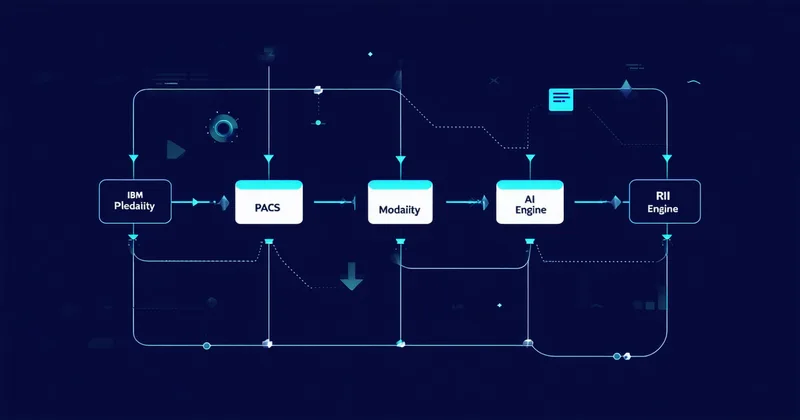
The ACR AI-LAB framework includes guidance on evaluating whether an AI tool integrates with existing PACS and RIS infrastructure without disrupting radiologist workflow. For community hospitals, this translates to concrete questions: Does the tool add a new dashboard the radiologist must monitor, or does it work within the existing worklist view? What is the configuration burden on the PACS administrator? Does it require dedicated server hardware or can it run on existing infrastructure or cloud?
Performance Monitoring Post-Deployment
One of ACR AI-LAB's strongest practical contributions is its emphasis on ongoing performance monitoring after initial deployment — not just evaluating the tool at procurement time and assuming it continues to perform acceptably. The framework recommends that practices track sensitivity/specificity for a sample of cases post-deployment, monitor alert rates over time, and have a process for addressing performance concerns with the vendor.
Community hospitals rarely have the staffing to implement a formal ongoing monitoring program. A practical adaptation is to request quarterly performance reports from the vendor — alert volume trends, processing failure rates, any model update notifications — as a contractual deliverable rather than an internal operation the hospital must staff.
What the Framework Doesn't Give You
The ACR AI-LAB framework is primarily designed for practices with enough clinical informatics capacity to execute a structured evaluation process. Some of its tooling assumes access to a reference radiologist reader to adjudicate a validation sample, a data governance framework to handle de-identified PHI for validation datasets, and an informatics team to configure and monitor integration. Community hospitals with two to five radiologists and a general IT team cannot practically implement the full framework.
We're not saying the ACR AI-LAB framework is inaccessible or irrelevant to community hospitals. We're saying that the full framework as written is designed for a resourcing level that most community hospitals don't have, and that applying it practically requires selecting the elements that are feasible and proportionate to your department's size.
The elements that are feasible without a formal AI governance committee: reviewing the vendor's published clinical evidence and asking the specific questions from the Clinical Validation domain (cohort composition, scanner mix, performance at your expected PE or ICH prevalence); requesting integration documentation specific to your PACS and RIS versions; negotiating quarterly performance reporting as a contract term; and defining a specific escalation path if you believe the AI tool is generating clinically significant false positives or misses post-deployment.
The RadElement and RadLex Connection
ACR's RadElement project maintains a library of Common Data Elements (CDEs) for standardized radiological reporting — structured, coded findings that radiology AI systems can use to express their output in a vocabulary that downstream systems understand without custom parsing. RadLex is the underlying ontology, maintained by the ACR and Radiological Society of North America (RSNA), that provides controlled vocabulary terms for anatomical locations, finding types, and modifiers used in radiology reporting.
For procurement decisions, the relevant question is whether an AI vendor's DICOM Structured Report or FHIR DiagnosticReport output uses RadElement CDEs or RadLex-coded finding terms, or whether it uses proprietary internal codes that cannot be mapped to standard vocabularies. Vendor-proprietary output codes create long-term interoperability risk: if you switch PACS vendors or add a new EHR integration, proprietary codes may not map correctly. Standards-based output using RadLex or SNOMED CT codes is more durable.
A Practical Procurement Checklist Adapted from ACR AI-LAB
For a community hospital procurement team with limited time for formal AI governance evaluation, a condensed ACR AI-LAB-derived checklist might look like:
- Does the vendor have published peer-reviewed clinical validation data? From what type of facility — academic or community?
- Does the vendor have FDA 510(k) clearance for the specific indications being claimed, or is clearance in progress?
- What is the integration mechanism with your specific PACS and RIS vendors?
- What is the vendor's process for notifying customers of model updates, and do model updates require revalidation?
- Does the vendor provide a BAA, and what PHI handling controls are in place?
- Can the vendor provide performance data from deployed community hospital environments specifically?
- What are the terms of a pilot program — duration, exit conditions, cost structure?
Pacslens's positioning explicitly aligns with the ACR AI-LAB spirit of evidence-grounded evaluation and honest performance representation. We support pilot program structures precisely because we believe that community hospitals deserve to evaluate performance in their own environment before committing to multi-year agreements — which is both the right clinical approach and consistent with what the ACR AI-LAB framework would recommend.
Want to discuss how Pacslens addresses the ACR AI-LAB evaluation criteria for your procurement process? Contact our clinical partnerships team for a structured evaluation conversation.